
Leonardo Papers: Hard Copy
Robert Mallary, Jack Burnham, and a two-page argument over an exhibition.

In April 1970, five months before Jack Burnham’s Software opened at the Jewish Museum, Leonardo published a two-page attack on it by the artist Robert Mallary. Burnham had announced an exhibition about information systems in art; Mallary, who had been generating sculpture by computer since 1967, argued from the press statements alone that the curator misunderstood his own subject, starting with the word software. When the show opened on September 16, its central computer failed and stayed dead for a month of the eight-week run.
Burnham, born in New York in 1931, and raised in Quincy, Massachusetts, served in the Army Corps of Engineers and took an associate degree in engineering at the Wentworth Institute before studying at the Boston Museum School, and finishing with a BFA and MFA from Yale. Naum Gabo, teaching at Harvard, became a mentor. For a decade from 1955 Burnham made light sculpture, incandescent bulbs, neon, electro-luminescent tape in aluminum channels, while working intermittently as a signpainter and draftsman.
By the late sixties he had stopped making art and turned to theory. He taught art history at Northwestern and in 1968 became the inaugural Fellow at MIT’s Center for Advanced Visual Studies, where he promptly fell out with György Kepes for insufficient enthusiasm about computers and took up instead with the computer scientists Oliver Selfridge and Jack Nolan. The same year Braziller published Beyond Modern Sculpture: The Effects of Science and Technology on the Sculpture of This Century, four hundred pages arguing that “technics,” not painting, had driven sculpture’s break with its past, and that the story would end in the attainment of sculpture’s oldest ambition, the simulation of life. The final pages predicted art forms of true intelligence before the century’s end, and beyond them the “programmed obsolescence of all natural organic life,” replaced by more efficient synthetic kinds. Later editions deleted that sentence. That September, Burnham’s Artforum essay “Systems Esthetics” declared the object in eclipse and made him one of the most discussed art theorists in America.
The Jewish Museum, which had given the New York avant-garde Primary Structures in 1966, allocated Burnham a budget, a corporate sponsor in the American Motors Corporation, and a building. He was not yet forty and had never curated a major show.
Mallary was fourteen years older. Born in Toledo in 1917, he left for Mexico City at nineteen, drawn by the political heat of the muralists, studying printmaking under the Czech expatriate Koloman Sokol and later experimenting with new media alongside Orozco. Mexico gave him his taste for industrial materials, polyester resin and Duco automotive lacquer. Back in California he drew swimwear advertisements at Cole of California alongside Wayne Thiebaud, and through the fifties built a national reputation as an assemblage sculptor, crushed tuxedos and street detritus fixed in resin, shown in the Whitney Annuals of 1960, 1962 and 1964, collected by MoMA and the Whitney.
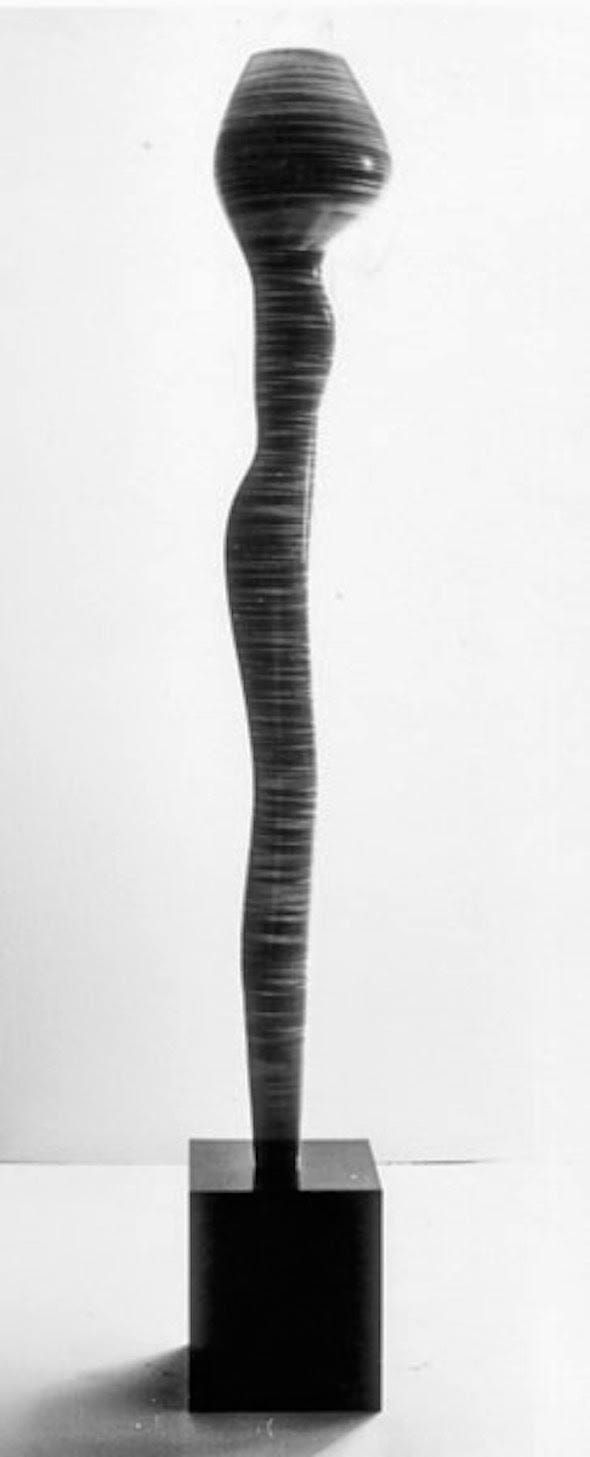
The resin poisoned him. In 1966 he took a professorship at UMass Amherst and turned to the computer, which let him design sculpture without touching the materials. With his son Michael, then a physics student at MIT, he wrote TRAN2, a Fortran program that generated sculpture as stacked contour slices: the artist drew two profiles, coordinates went onto punch cards, the Amherst College IBM 1130 computed hundreds of contour points per horizontal slice, a plotter drew each layer, and the layers were band-sawed, stacked, glued and sanded. Anyone who has watched a 3D printer will recognize the procedure. Quad III went into the Whitney’s 1968 Sculpture Annual, the first computer-generated sculpture shown in an American museum; Cybernetic Serendipity showed it the same year; his May 1969 Artforum essay, “Computer Sculpture: Six Levels of Cybernetics,” laid out a taxonomy running from the computer as passive tool up through genuine machine autonomy, and cited Burnham’s book with respect.
Burnham had defined the show’s subject as “electronically supported software” and offered as examples the radio, the telephone, television, teletype and teaching machines. Mallary pointed out that every item on the list is hardware. Software is programming input, a term with a precise origin in punched cards and paper tape; it constituted, he noted, roughly half the overhead costs of the computer industry, and its meaning was too specific and too useful to be smeared across any electronic device. To call a television image software was to drain the word of meaning. If the show was going to be about output devices, Mallary suggested, Burnham should call it Hard Copy.
His larger complaint was that Burnham had never defined “systems art” except negatively, as the repudiation of the sculptural object, and had borrowed the prestige and vocabulary of cybernetics without its discipline, ignoring the distinction any systems theorist observes between the abstract model and the real-world system it describes. Mallary wanted cybernetic art to succeed. He asked why an art of systems should exclude the physical at all; astronauts were walking on the Moon that year because software and hardware had been engineered as one system, so why should artists have to choose?
He was even generous about the outcome: perhaps the show would at least force Burnham to define his phrase. Burnham replied in the same volume, “Comments on Mallary’s Note,” and Mallary came back with the UMass computer scientist Caxton C. Foster in “Further Comments on Software and Hardware.” A definitional quarrel between a sculptor and a curator, refereed in public, with references and received dates, across a peer-reviewed journal. Leonardo was two years old, founded in Paris by Frank Malina, precisely so that artists working with science could argue at this level.
The catalogue, when it appeared, suggested the exchange had left a mark. Burnham’s essay, dated June 1970, devotes paragraphs to the word: its original sense as the changeable part of a computer system, the hardware-software tradeoff, firmware, and publishing’s habit of calling content software, a usage Burnham himself calls unfortunate. His technical adviser was Ted Nelson, the inventor of hypertext, whose examples in the catalogue run from traffic rules as the software of a transportation system down to human behavior as the software of the body. Burnham said Cybernetic Serendipity had documented computing, but Software would put working computers inside a museum, “a sizable technical feat which the earlier exhibition did not attempt.”
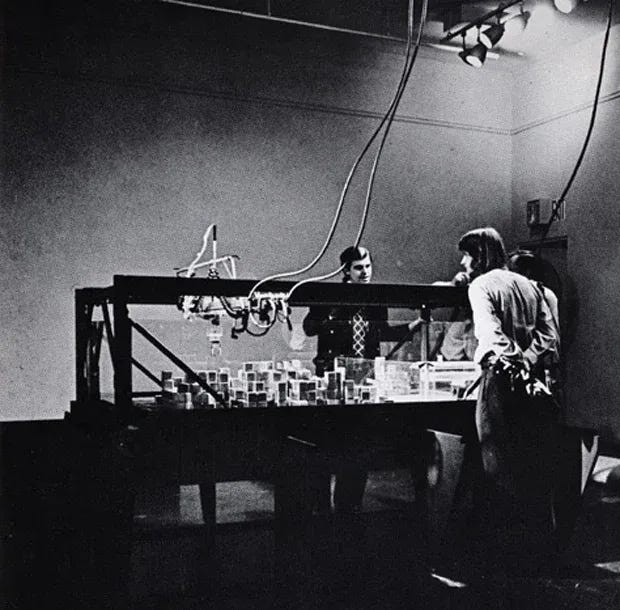
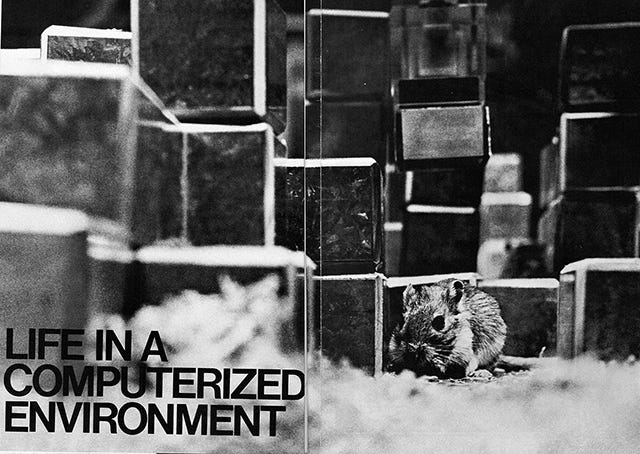
The show opened on schedule with an artist list that reads today like a conceptualism syllabus: Haacke, Kosuth, Baldessari, Acconci, Agnes Denes, Barry, Huebler, Paik, David Antin, alongside the technologists from MIT. Burnham had installed it, he later revealed, on the architectural model of Duchamp’s Large Glass. The catalogue itself was an artwork, Ted Nelson’s Labyrinth, a computerized text-retrieval system that let visitors browse artist files non-sequentially at terminals and print a record of their path, generally credited as the first public demonstration of hypertext. The show’s emblem was Seek, the Architecture Machine Group installation in which Nicholas Negroponte’s robot arm rearranged toy blocks in response to the interference of live gerbils, a computer trying and failing to model the desires of its inhabitants. Haacke’s Visitors’ Profile was built to cross-tabulate the audience’s demographics against their opinions on marijuana and Vietnam through a terminal on a time-sharing computer; how much of it ever ran is unclear from the record. Baldessari contributed his Cremation Project, the ashes of the paintings he had burned that summer. Acconci’s contribution was to stand uncomfortably close to strangers.
The central computer, a DEC PDP-8, failed and stayed down for roughly a month; the gerbils of Seek began attacking each other. Les Levine and John Giorno accused the museum of censorship, Giorno over blocked Eldridge Cleaver tapes. The budget overran badly enough to feed a genuine institutional crisis: the director Karl Katz lost his job, and the board reportedly voted that future exhibitions relate directly to Judaism, ending the museum’s decade at the center of the New York avant-garde. A Smithsonian showing was scheduled for mid-December. Burnham’s curatorial career ended here; he never organized another exhibition.
Grace Glueck’s New York Times review ran under the word “Confusing.” The notice worth rereading is Kenneth Baker’s, in the December Artforum. Baker observed that some of the machinery had “fallen into disrepair (or risen to it)” by the time he visited, and his objection went past the breakdowns: the cybernetic model of experience the show was selling was, he argued, only a mechanical model with better manners, and a museum that lent itself to an event whose own literature denied being an art exhibition had, for two months, stopped being a museum. The one work he admired without reservation was Haacke’s News, teletype machines printing the world’s wire services into heaps on the gallery floor. Half a century on, that is the piece from Software that institutions restage.
The breakdowns all fell on Mallary’s side of the definition. Burnham had treated hardware as incidental packaging for the ideas; the packaging failed in public, and for most visitors the dead terminals were the show.
Yet on the word itself, time sided with Burnham. Within fifteen years the consumer-electronics industry was calling films and records software for its players, and the engineers lost custody of the term for good. Baker, scoffing that the hardware-software split was as crude a dichotomy as form and content, invited his readers to imagine what an exhibition named after the latter term might look like.
The instructive comparison had opened three miles south that same summer. Kynaston McShine’s Information ran at MoMA from July to September 1970 with much of the same artist list, Haacke, Kosuth, Barry, Huebler, Baldessari among them, and none of the disasters. McShine was a professional inside a functioning bureaucracy; Burnham had bet the museum on a thesis.
That bet defines a curatorial type which has nearly disappeared: the artist who curates. The lineage runs back through Duchamp, who hung twelve hundred coal sacks from the ceiling of the 1938 surrealist exhibition in Paris and webbed the 1942 First Papers of Surrealism in string, and through the artist-and-architect teams, Richard Hamilton’s among them, who built This Is Tomorrow at the Whitechapel in 1956. In Burnham’s own moment it included Willoughby Sharp, the artist who curated Earth Art at Cornell in 1969, co-founded Avalanche, and interviewed Burnham for Arts in November 1970, mid-debacle, and Otto Piene, the Zero founder who took over the CAVS directorship at MIT and held it for twenty years. Its fullest later case is Peter Weibel, the Viennese performance artist and Valie Export collaborator who spent a quarter century running the ZKM in Karlsruhe and built thesis exhibitions on Burnham’s scale and larger. Since curating became a graduate degree in the 1990s, museums have mostly stopped taking the risk of the artist-curated exhibition. Weibel, who died in 2023 still running his museum, may have been the last with real institutional power.
Burnham’s own retreat began almost immediately. In 1972 he published an Arts Magazine essay reading Duchamp’s Large Glass as alchemy, and a 1973 Guggenheim fellowship funded the pursuit. He still mattered enough in those years that Joseph Beuys mailed a postcard on his behalf, later a Staeck multiple, asking that Jack Burnham be allowed to eat his dinner in peace. The formal concession came in 1980 with “Art and Technology: The Panacea That Failed,” in which the movement’s principal theorist wrote its obituary and listed his own show among the casualties.
The February 1988 Artforum roundtable records where the retreat ended. Burnham, then fifty-six and teaching at Maryland, dismissed the pace of stylistic change as a symptom of a dysfunctional system, compared contemporary art to a grapefruit rind fished from a hotel garbage can and squeezed for its last drops, and declared that scientific objectivity eventually proves wrong while myth alone endures. His example was the van Gogh that had just sold for $53.9 million: the buyer, he said, was purchasing not a painting but the myth of a solar hero, mocked in life, dead by his own hand, resurrected at auction. Twenty years earlier this man had staked a four-hundred-page book on the empirical method and predicted that art would culminate in synthetic intelligence. Now he was arguing that empiricism refutes itself and that art’s function is to prepare people for a spiritual wintertime.
In a 1981 letter to the critic Michael Bonesteel, now posted on Robert Horvitz’s Burnham archive, Burnham described five years of accumulating symptoms, chronic guilt, obsessive anger and a self-rejection deep enough to drive him out of his own career. The same year he told a friend he would pass on rejoining society. At Maryland, after his divorce, he lived for a period in his office, suffered a breakdown and resigned. He died in February 2019 in Hyattsville, Maryland, immersed in the Kabbalah, so far from the art world that the obituaries carried a note of surprise he had still been alive.
Mallary, meanwhile, ran the Computer Graphics Workshop at UMass Amherst, made plotter drawings and digital collage into the 1990s, returned to assemblage in the late eighties, and died in 1997 still working.
Burnham’s rehabilitation came through the academy. Tate’s 2005 Open Systems reprinted “Systems Esthetics” in its catalogue, and Software is now among the most cited exhibitions in the literature of art-and-technology curating, its disasters retold with affection.