
Murray Hill in Zagreb
Two Bell Labs papers in bit international No. 2, 1968

Between October 1967 and February 1969, IEEE Spectrum published two technical papers from Bell Telephone Laboratories at Murray Hill that did more to legitimize computer-generated images as art than any manifesto by any artist of the period. M. R. Schroeder’s paper read as a hardware report on producing half-tones from a microfilm plotter. A. Michael Noll’s read as a survey of computer applications in music and the visual arts. The editorial team of bit international, a new theoretical journal launched in Zagreb under the New Tendencies umbrella, reprinted both in their second issue, dated 1968. The two papers, read together, supply the empirical and aesthetic warrant for everything else in the volume.
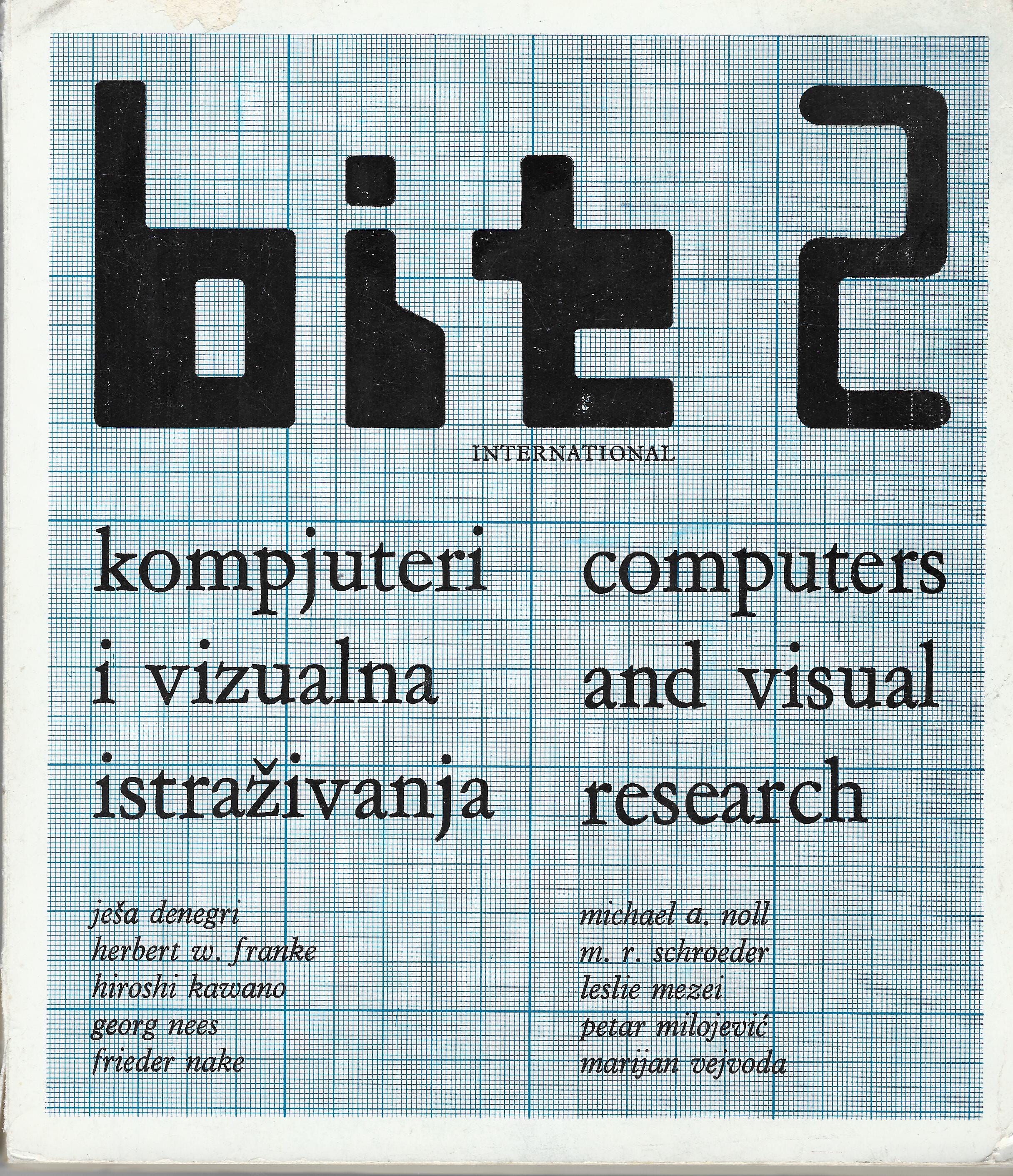
bit 2 contains ten essays. Eight come from European and Japanese theorists and practitioners — Denegri, Franke, Kawano, Nees, Nake, Mezei, and the Zagreb pair Milojević and Vejvoda. The other two are the Bell Labs reprints. Their position in the issue is, in itself, the structural argument of the volume.
Manfred Schroeder was a German physicist who joined Bell Laboratories in 1954, the year of his Göttingen doctorate, and became director of acoustics and speech research at Murray Hill in 1963. By the time the half-tone paper appeared in IEEE Spectrum he had spent fifteen years on problems in concert hall acoustics, speech coding, and number theory. The Schroeder frequency and the Schroeder reverberator were in the literature; the linear-predictive-coding work with Bishnu Atal that would become the basis of cellular speech compression was just beginning. In the late 1960s, with time on the IBM 7094 and a Stromberg-Carlson 4020 microfilm plotter that could illuminate any of just over a million points on a phosphorescent screen but could not produce gray, he set himself the problem of making photographs. His test image, an uncredited young woman against a patterned curtain, runs through the entire paper. He develops four strategies for converting her into half-tones, the last and best of which weighs each pixel against a 3 × 3 spatial average of already-plotted neighbours, and under the resulting blow-up of her lip, he describes the result as a brush technique the computer arrived at on its own.
Through page 70 the paper does exactly what an engineering paper should. Then Schroeder stops doing engineering.
He plots f(x,y) = 1 if x and y are coprime, 0 otherwise, across a 256 × 256 grid; about sixty per cent of the points are illuminated, corresponding to 6/π², the reciprocal of Riemann’s zeta function at argument 2. He takes the two-dimensional Fourier transform of the same function and prints its spectrum. He fills the woman’s left eye with the letters of ONE PICTURE IS WORTH A THOUSAND WORDS, repeated and exposed between one and forty times against local brightness. He plots concentric circles modulated to her tone. He encrypts the portrait with a binary key and decrypts it by photographic superposition. He simulates Brownian motion that goes wrong because of a programming bug, lets the figure stand, and writes that perhaps the computer knew something he didn’t.
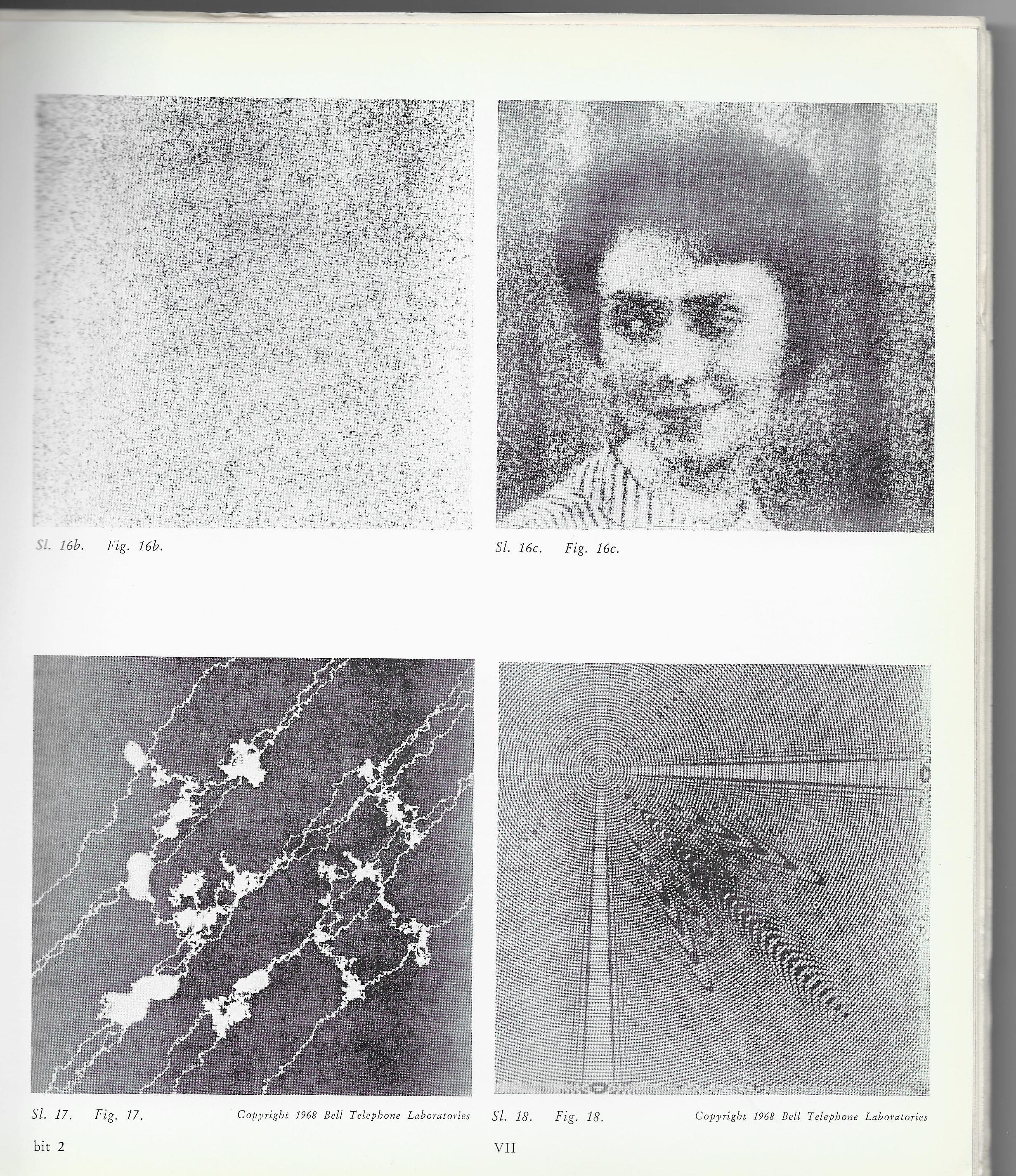
Then he prints Figure 18, captioned simply Programming error, with the following declaration:
It is said that some discoveries have been made by accident or miscalculation. Have any new insights been gained by programming error or computer miscalculation? Perhaps. In any case, nonsense calculations can be beautiful if allowed to manifest themselves geometrically.
That sentence, dropped into an IEEE Spectrum technical paper by a Bell Labs research director, is the aesthetic warrant Zagreb had spent the previous iterations of New Tendencies trying to construct in theory. It arrives from inside the laboratory, in an engineer’s voice, with a figure as evidence.
Twelve pages earlier in the same volume, A. Michael Noll had done his version of the move, deliberately, with statistics. Noll knew the SC-4020 microfilm plotter because, six years earlier, he had used it on a summer assignment to Schroeder’s acoustical research department, where Schroeder had supervised him on cepstrum pitch detection. The first computer images Noll made were a side effect of that work.
Noll, thirteen years younger than Schroeder, had grown up in Newark in a household where neither parent had finished high school. He went to Saint Benedict’s Preparatory School, took his BSEE at Newark College of Engineering in 1961, and joined Bell Labs after graduation. The hi-fi store in Newark where he had worked as a salesperson through college had pointed him at Bell, where the audio research was. In the summer of 1962, on a temporary assignment from Human Factors to acoustical research, he was put to work on cepstrum pitch detection under Schroeder. His first computer images, documented in a Bell Labs technical memorandum titled “Patterns by 7090” (MM-62-1234-14) and dated August 28, 1962, were a side effect of running speech data through Schroeder’s plotter. Computer Composition with Lines came in 1964, when Noll was twenty-five.
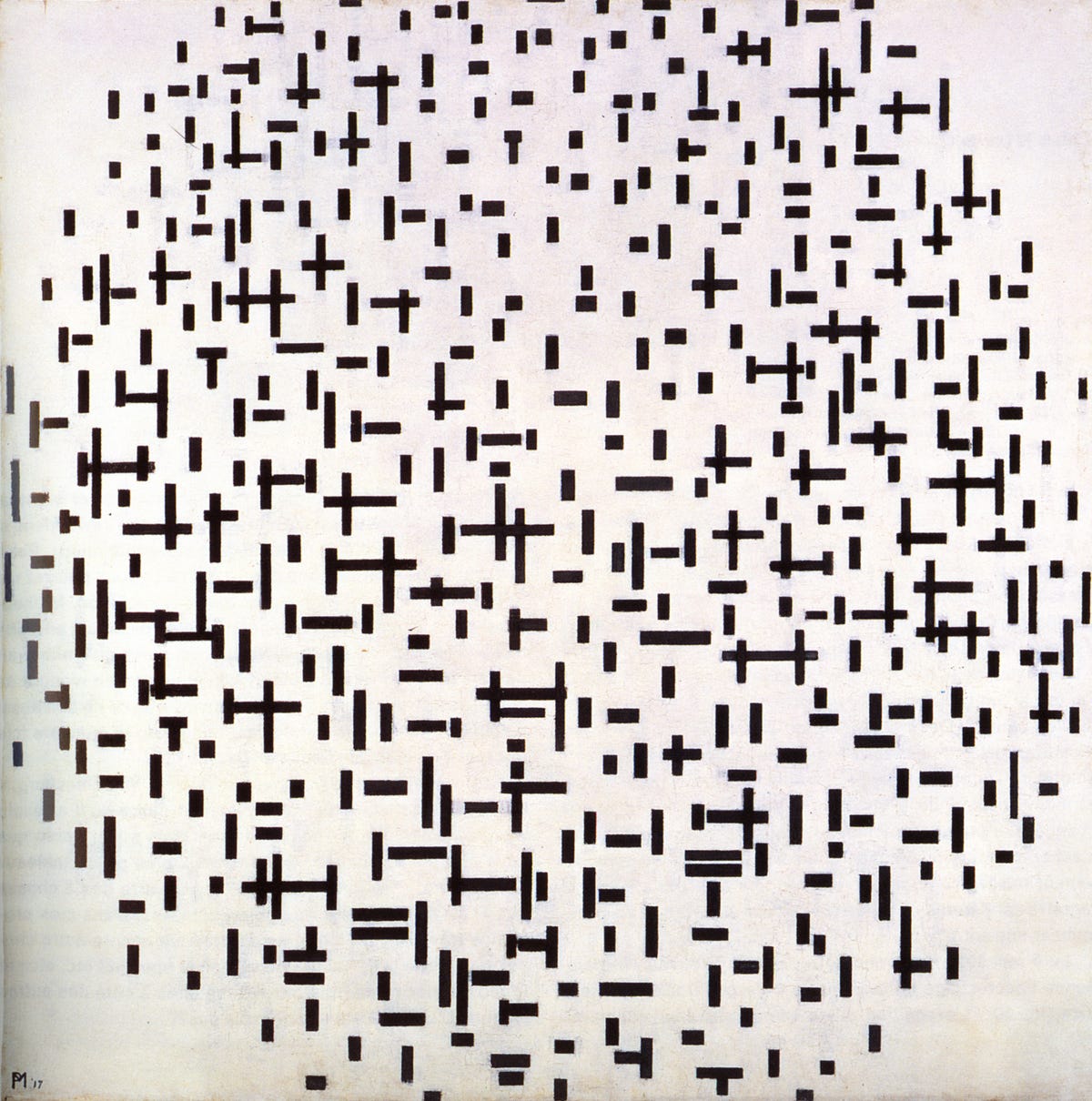
The empirical centrepiece of his paper sits on page 57. Mondrian’s Composition with Lines of 1917, then in the Kröller-Müller museum, has been set beside a computer-generated picture composed of pseudo-random elements. Although Mondrian had placed his vertical and horizontal bars carefully and in an orderly manner, the bars in the computer-generated picture were placed by a pseudo-random number generator with statistics chosen to approximate the bar density, lengths, and widths in the Mondrian. Xerographic copies of the two were shown side by side to one hundred adults with educations ranging from high school to postdoctoral. They were asked which they preferred, and which they thought Mondrian had produced.
Fifty-nine per cent preferred the computer-generated picture. Only 28 per cent correctly identified the Mondrian original.
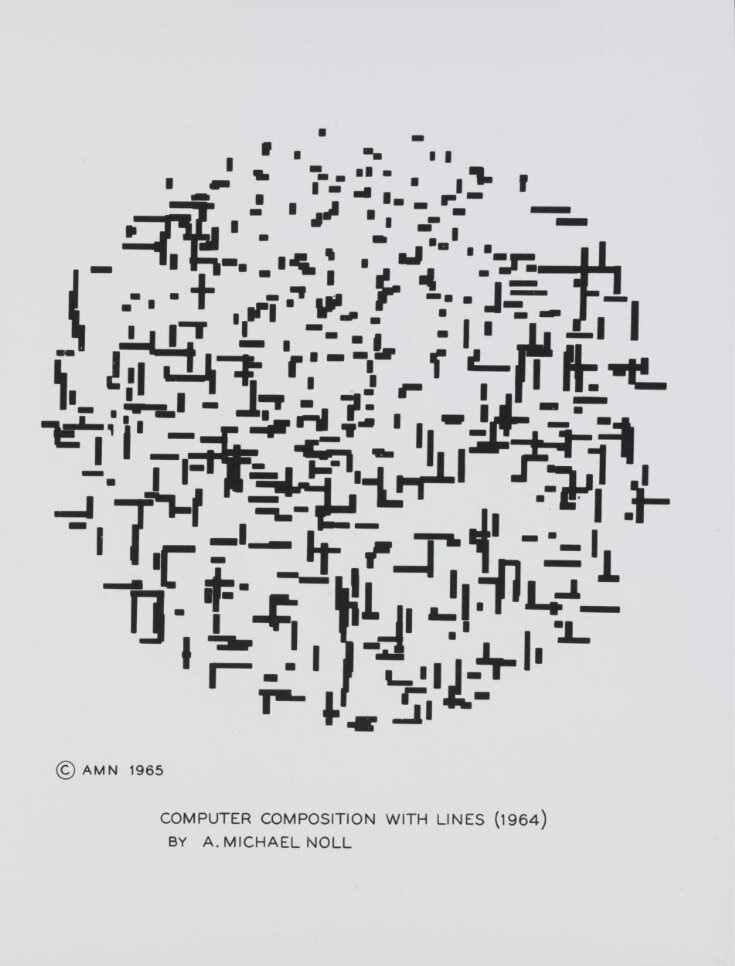
Noll’s interpretation is careful. People seemed to associate the randomness of the computer-generated picture with human creativity, while the orderly bar placement of the Mondrian seemed machinelike. The result does not, he notes, detract from Mondrian’s abilities (the painting was, after all, the inspiration for the algorithm), but it does suggest that the audience’s idea of what constitutes a creative gesture is the opposite of what was actually creative in this case. The two images are reproduced on plate II of bit 2: Mondrian on top, Noll’s Computer Composition with Lines below, the two roughly circular arrangements of black bars set side by side. Noll’s image carries the credit line “copyright AMN 1965.”
The argument that brackets the experiment is simpler than it sounds. Painting, properly described, already involves a program of step-by-step action; Noll uses the Matisse anecdote of the red disk on a blank canvas to make the point. The computer is the medium in which that program becomes explicit. It is also a new medium. The statements that grow out of the artist’s engagement with it, Noll writes, will not be similar to the statements of oil paintings.
The rest of the paper he describes a real-time music console at Bell Labs with light-pen input on a CRT, proposes the same arrangement for choreography with three-dimensional stick figures, and outlines interactive aesthetic experiences in which the artist’s emotional state is monitored by EEG and pulse rate and the environment around the artist altered to optimise the aesthetic effect. Writing in 1967 for an IEEE engineering audience, he allows himself one editorial flourish:
One is strongly tempted to describe these ideas as a consciousness-expanding experience in association with a psychedelic computer!
The exclamation mark is his. He then projects forward. Three-dimensional computer-generated colour displays that surround the individual are already within the state of the art. The artist of the future will be freed from technical competence in any one medium. What will matter is the artist’s ideas, not their hand. A new kind of “citizen-artist” could emerge, drawing on the leisure time predicted for the man of the future.
What did Boris Kelemen, Radoslav Putar, and Matko Meštrović hear in these two papers? The Bense-Moles information aesthetics being developed in Stuttgart and circulated through Zagreb required, to be credible, that engineers and mathematicians actually working with computers recognised a category of computational beauty independent of intention or representation. Most of the practitioners bit published were arguing the case as artists, with the predictable suspicion that comes when artists make claims about their own medium. Schroeder makes the case from inside Murray Hill, in passing, as if it were obvious. Noll makes it from the same lab, deliberately, with a controlled experiment showing that one hundred adults at a major research laboratory cannot reliably distinguish a Mondrian from a pseudo-random imitation and prefer the imitation when asked. For an editorial team building a theoretical journal in Zagreb in 1968, those two papers in one volume did an enormous amount of work in a short space.
A note on the two engineers’ subsequent careers, which moved in opposite directions.
Schroeder’s own life moved out of Murray Hill the year his paper appeared. In 1969 he accepted a chair at Göttingen, where his doctoral advisor Erwin Meyer had taught him, and split his time between Bell Labs and Göttingen until his retirement from Bell in 1987. The same year he took the chair, he won a first prize in an international computer art competition, which is to say that the editors of IEEE Spectrum had not been the only readers to find his half-tone paper interesting on grounds other than engineering. He died in Göttingen in 2009. The Schroeder reverberator is still in use; the linear-predictive-coding methods he developed with Atal between 1967 and 1985 underlie most of the cellular voice codecs in service today.
Noll’s path was different. He left Bell in 1971, the day he received his Brooklyn Poly doctorate, for two years at the White House Science Advisor’s office, returned to Bell from 1973 to 1977, then transferred to AT&T’s Consumer Products and Marketing Department to work on technical evaluations of new products and services such as teleconferencing and videotex. He joined the USC Annenberg School in 1984 and served as interim dean from 1992 to 1994. He has published ten books, more than ninety-five papers, and holds six patents. Over half a century he has also been the principal documentary historian of his own field, posting primary materials to his USC Annenberg site and litigating priority claims with patience and exactitude. Patterns by 7090, the August 1962 Bell Labs memorandum that records his first computer images, predates Nake’s Stuttgart work and Nees’s Erlangen work.
The market for Noll’s work is shaped by that institutional density. His prints and films are in the Museum of Modern Art, the Victoria & Albert, the Los Angeles County Museum of Art, the Centre Pompidou, the New York Public Library at Lincoln Center, the Academy of Motion Picture Arts and Sciences, and the Dibner Library at NYU. Vintage prints rarely become available. When they do, Computer Composition with Lines carries a documentary anchor that no other work of early computer art possesses: the 1966 Psychological Record paper, with its statistically structured experiment on one hundred adults. It is the only image in the canon whose meaning was tested empirically before its market existed.
Many thanks for this hugely insightful article, Robert - I really enjoyed reading it!